
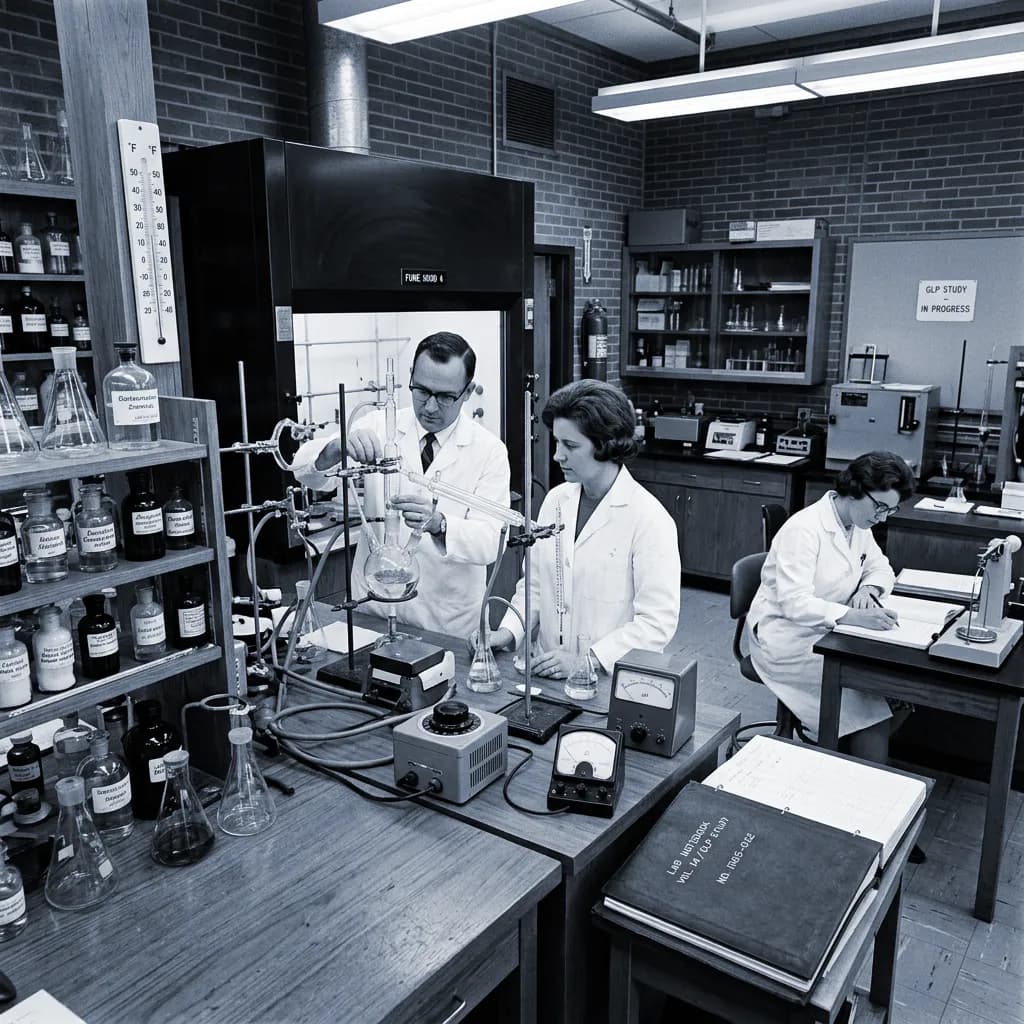
How do test facilities meet GLP requirements under the OECD Principles without being cited during regulatory monitoring?
Our GLP consulting supports test facilities in building Good Laboratory Practice compliant processes to the OECD principles: gap analysis, SOPs, raw data and archive management. A test facility passes the inspection on the evidence chain from raw data to final report, not on individual SOPs.
Overview
Which GLP requirements arise in test facilities?
GLP support for pharma, biotech, MedTech and IVD · OECD Principles of Good Laboratory Practice
Last updated: October 4, 2026
The OECD Principles of Good Laboratory Practice (GLP) are mandatory for non-clinical safety studies whose results are submitted to authorities for the approval of medicinal products, biocides or chemicals; for medical devices, the MDR requires GLP conformity only where applicable (Annex II, Section 6.1(b)). In the EU these principles are harmonized through Directive 2004/10/EC; in Germany implementation is handled via the Chemicals Act (ChemG).
- Standard operating procedures (SOPs) are missing, outdated or not structured in a GLP-compliant way, so that the actual conduct deviates from the documented method.
- Raw data capture and audit trail do not meet the GLP requirements for data integrity, particularly with electronic laboratory systems (LIMS) that lack validated traceability.
- Archiving and sample management do not conform to the OECD principles, for example with regard to retention periods, access control and retrievability of study records.
- The Quality Assurance Unit (QAU) is not set up with sufficient independence from study direction, or its study-based, process-based and facility-based inspections are not documented without gaps.
- Traceability from the raw data through the evaluation to the final report is broken, so that the authority cannot follow the study integrity end to end.
Services
How we support you
GLP gap analysis & readiness assessment
Systematic assessment of the test facility's GLP status against the OECD principles. The result is a prioritized action plan with concrete steps for each core process on the path to GLP compliance.
GLP process & SOP development
Preparation of GLP-compliant SOPs for all core processes: study management, raw data capture, archiving, sample management, equipment qualification and personnel qualification, including the master SOP list with version control.
Setting up the Quality Assurance Unit (QAU)
Establishing a QAU independent of study direction, with an inspection plan for study-based, process-based and facility-based inspections, along with documented QAU statements for every study.
How we work together
What it comes down to
The OECD Principles of Good Laboratory Practice do not assess polished documents, but an end-to-end chain of evidence. The chain has to line up, and in the right order: the SOPs define how an activity is to be carried out. The raw data capture has to prove that the study was conducted exactly that way.
And the Quality Assurance Unit has to confirm independently that the final report accurately reflects the raw data. If the raw data definition or the audit trail in the LIMS is clarified too late, the raw data capture becomes the critical point, because integrity cannot be created after the fact, only documented or not.
The gap analysis comes first and determines where the critical path runs, before SOPs are written and systems are validated.
The work then sits in defining what constitutes raw data in the specific procedure and how the Quality Assurance Unit is set up to be independent, rather than in the test facility inspection, where a broken chain of evidence is no longer repairable and GLP recognition is at risk.
Our approach
Our approach
Step
Result
Gap analysis
Prioritized action list for each GLP core process: where the test facility stands against the OECD principles, what is critical, and what is effort.
SOP & process build-up
GLP-compliant SOPs for study direction, raw data, archive, samples, equipment and personnel, with version control and a master list.
Data integrity & LIMS
An assessed and traceable audit trail, documented access control, and a raw data lifecycle from capture through archiving.
QAU & study integrity
An independent Quality Assurance Unit in operation, the inspection plan worked through, and end-to-end traceability up to the final report.
Mock audit
Findings report with CAPA plan, critical findings closed, inspection interviews prepared.
Test facility inspection
Supported regulatory inspection, structured handling of the citations, GLP recognition obtained or confirmed.
Common pitfalls
Where projects commonly fail
SOPs describe a target process that diverges from actual practice.
The inspection compares raw data and laboratory notebooks against the valid SOP; any deviation without documented justification becomes a citation, regardless of how cleanly the SOP is worded.
The raw data definition is unclear.
If it is not established what constitutes raw data in the specific procedure (instrument printout, electronic data record or laboratory notebook entry), a gap opens in the chain of evidence that the authority routinely addresses.
The audit trail in the LIMS is not validated or can be disabled.
If it can be altered after the fact who captured or corrected a measurement, GLP data integrity cannot be demonstrated; this ties closely to computer system validation and 21 CFR Part 11 where there is an FDA nexus.
The Quality Assurance Unit is not independent.
If the QAU effectively reports to study direction, or documented QAU inspections are missing, one of the central pillars of the OECD principles falls away, which weighs heavily in the facility inspection.
The archive meets the requirements formally but not functionally.
Retention periods are on file (15 years in Germany under Annex 1, No. 10.2 ChemG), yet access control, a named archivist and demonstrable retrievability of the study records are missing, so the integrity of long-term storage is not substantiated.
Quality Management & Compliance
Do any of these pitfalls apply to you?
In a first call we assess your situation and say what needs clarifying first in your case. Without obligation, reply usually within one working day.
FAQ
Frequently asked questions
Sources
- OECD Principles of Good Laboratory Practice (GLP): primary text
- Directive 2004/10/EC and Directive 2004/9/EC (EU harmonization and GLP inspection)
- Chemicals Act (ChemG): national implementation of the GLP principles in Germany
Image notice: The images on this page were generated using artificial intelligence. They do not depict real people, places, or events.
Life Science Journal
Regulatory updates, straight to your inbox.
New requirements, authority decisions and practice notes. Once a month, unsubscribe any time.
Projects from this industry
What we have worked on in this industry


Latest insights
All insights →Regulations & standards considered
- OECD Principles of Good Laboratory Practice (GLP)
- Directive 2004/10/EC (harmonization of GLP principles in the EU)
- Directive 2004/9/EC (inspection and verification of Good Laboratory Practice)
- Chemicals Act (ChemG): national implementation of the GLP principles in Germany
Related topics
GxP Audits (GMP, GLP, GCP) →
Cross-GxP audits beyond GLP
Computer System Validation (CSV) →
Validation of LIMS and electronic laboratory systems for GLP data integrity
Inspection Readiness →
Preparation for the regulatory test facility inspection
Quality Management →
Overarching QM system into which the GLP processes are embedded
Have a concrete project?
Briefly outline your situation. We'll respond with an initial assessment, usually within one business day.
Prefer direct? +39 02 8904 1000
info@theentourage.it
- Reply usually within one working day
- 4 locations: DE · CH · IT · US
- 100% life sciences