
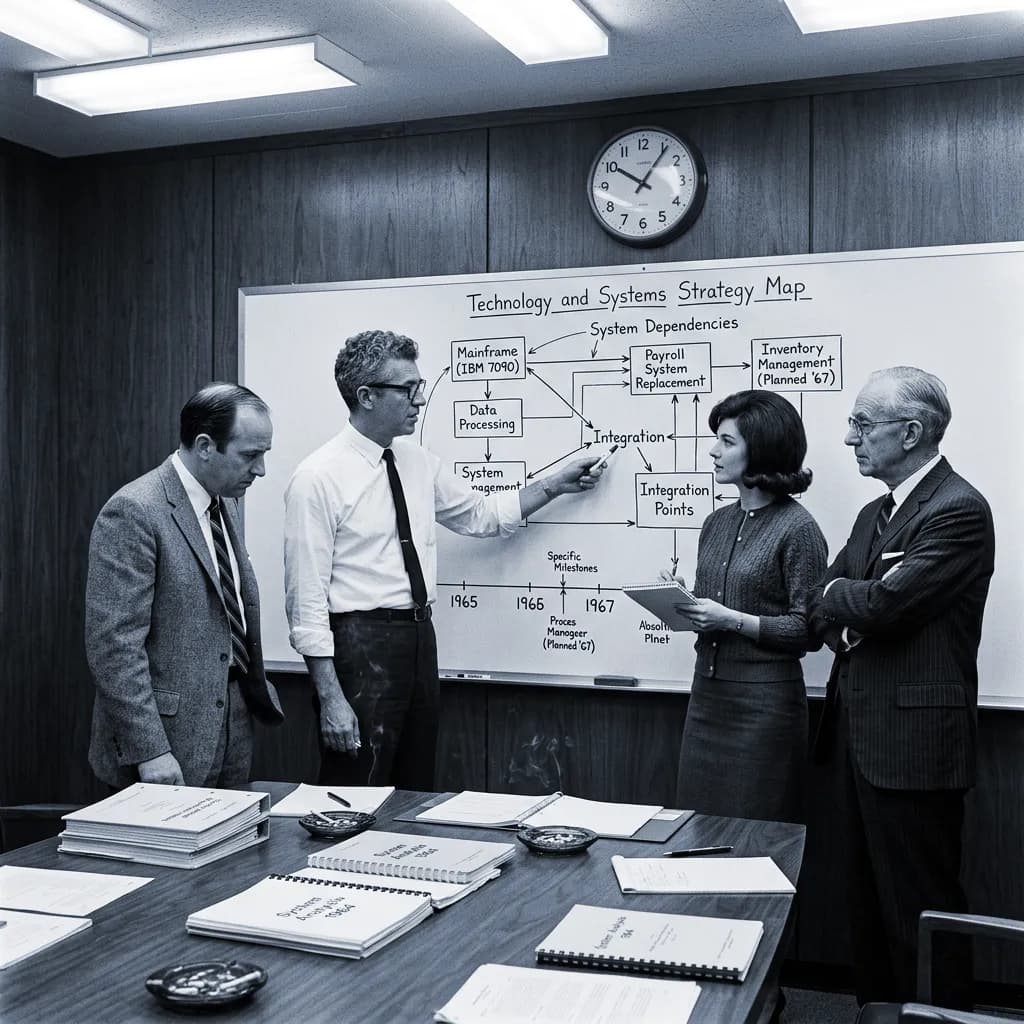
What does technology excellence mean in life sciences, when technologies have to be deployed in a GxP-compliant way and operated productively without accumulating technical debt?
We guide Technology Excellence across the technology lifecycle: assessing existing IT landscapes, structured selection, implementation and optimization in productive operation. Checking validatability, supplier qualification and audit trail capability per Annex 11 already at selection avoids validating a system never meant for GxP.
Overview
Why do technology projects in life sciences so often fail at implementation?
Support across the full technology lifecycle · Selection screening against Annex 11 (EU GMP Guidelines) and 21 CFR Part 11
Last updated: June 13, 2026
The technology leap in the industry is real, yet implementations usually miss their target not because of the technology but because of organically grown structures, missing upfront regulatory screening and underestimated change effort.
- IT landscapes grow historically without an overarching architecture: silos, duplicate data entry and integration problems arise because systems were introduced individually rather than as an integrated whole.
- Technology selection happens without a structured process: requirements specification, total cost of ownership and vendor lock-in are underestimated, and regulatory validation readiness is considered too late.
- GxP requirements are not taken into account from the start: computer system validation, audit trail capability under Annex 11 of the EU GMP Guidelines and electronic records under 21 CFR Part 11 slow deployments considerably when they are bolted on afterward.
- Change management is underestimated: acceptance and depth of use fall short of expectations because the organizational rollout is neglected in favor of the technical go-live.
Services
How we support you
Technology strategy & roadmap
Current-state analysis of the existing IT landscape, a target vision and a prioritized technology roadmap. The result is an investment list weighted by business value and regulatory risk that ties each measure to a business case.
Technology assessment & selection process
Structured selection with a requirements specification, RFI/RFP process and demo evaluation. The result is a weighted scoring matrix including upfront regulatory screening (validation readiness, audit trail, supplier qualification) and a total cost of ownership comparison.
How we work together
What it comes down to
In life sciences, a technology project is decided at procurement, not at rollout.
Companies that buy first and only afterward ask whether a system delivers a complete audit trail under Annex 11 of the EU GMP Guidelines and compliant electronic records under 21 CFR Part 11 have created the most expensive bottleneck themselves: validating a system that was never designed for GxP data.
Upfront regulatory screening therefore belongs in the selection phase, not in the validation project, because corrections there are far more expensive and the vendor lock-in has already set in.
The technology assessment shows from the outset which systems add value and which slow things down, before validation readiness, supplier qualification and total cost of ownership are weighed against each other in the structured selection.
Only once this decision is documented does implementation proceed in lockstep with computer system validation: the risk-based scope follows GAMP 5, and the validation plan is created in parallel with the project plan rather than afterward.
Early on, a wrong turn is still a stroke of the pen and not a finding in the audit.
Our approach
Our approach
Step
Result
Technology assessment
Assessed current-state landscape: which systems add value, which slow things down, and where silos and duplicate data entry sit.
Strategy & roadmap
Prioritized investment list by business value and regulatory risk, each measure with a business case.
Selection & upfront screening
Weighted scoring matrix with a supplier decision, documented validation readiness and total cost of ownership.
Implementation
Deployed system with user acceptance testing and a validation plan coordinated with computer system validation.
Optimization & integration
Consolidated system landscape connected through defined interfaces in productive operation.
Common pitfalls
Where projects commonly fail
Validation readiness is checked only after selection.
A system that processes GxP-relevant data but offers neither a complete audit trail under Annex 11 of the EU GMP Guidelines nor compliant electronic records under 21 CFR Part 11 can hardly be validated compliantly after the fact, and by then the vendor lock-in is already in place.
Systems are introduced individually rather than as an integrated whole.
Without an overarching architecture, silos and duplicate data entry arise; every later integration costs more than an interface strategy planned from the start.
Total cost of ownership is reduced to license costs.
Validation, interfaces, training and the ongoing change control effort under GAMP 5 are missing from the business case and blow the budget after the contract is signed.
Change management is confused with user training.
If the organizational rollout lags behind the technical go-live, depth of use declines and the expected efficiency gains fail to materialize.
Supplier qualification is skipped.
Without a documented assessment of the validation documentation and the supplier's GxP maturity, the audit lacks evidence that the system was selected following a risk-based approach in accordance with GAMP 5.
Supply Chain & Technical Operations
Do any of these pitfalls apply to you?
In a first call we assess your situation and say what needs clarifying first in your case. Without obligation, reply usually within one working day.
FAQ
Frequently asked questions
Sources
- EudraLex Volume 4, Annex 11 (Computerised Systems), primary text
- 21 CFR Part 11 (Electronic Records; Electronic Signatures), primary text
- GAMP 5: A Risk-Based Approach to Compliant GxP Computerised Systems (ISPE)
Image notice: The images on this page were generated using artificial intelligence. They do not depict real people, places, or events.
Life Science Journal
Regulatory updates, straight to your inbox.
New requirements, authority decisions and practice notes. Once a month, unsubscribe any time.
Case Studies
What this looks like in practice

Latest insights
All insights →Regulations & standards considered
- EudraLex Volume 4, Annex 11 (Computerised Systems)
- 21 CFR Part 11 (Electronic Records; Electronic Signatures)
- GAMP 5 (ISPE, Good Automated Manufacturing Practice)
- ISO 13485:2016 (QM system for medical devices)
- EU 2017/745 (MDR)
- EU 2017/746 (IVDR)
Related topics
Computer System Validation (CSV) →
CSV evidence under Annex 11 and GAMP 5 for selected systems
ERP Integration →
Integration and consolidation of organically grown system landscapes
Digitalization in Life Sciences →
The overarching transformation framework beyond technology selection
IT Process Management →
Operation and governance of the deployed IT processes
Have a concrete project?
Briefly outline your situation. We'll respond with an initial assessment, usually within one business day.
Prefer direct? +39 02 8904 1000
info@theentourage.it
- Reply usually within one working day
- 4 locations: DE · CH · IT · US
- 100% life sciences