
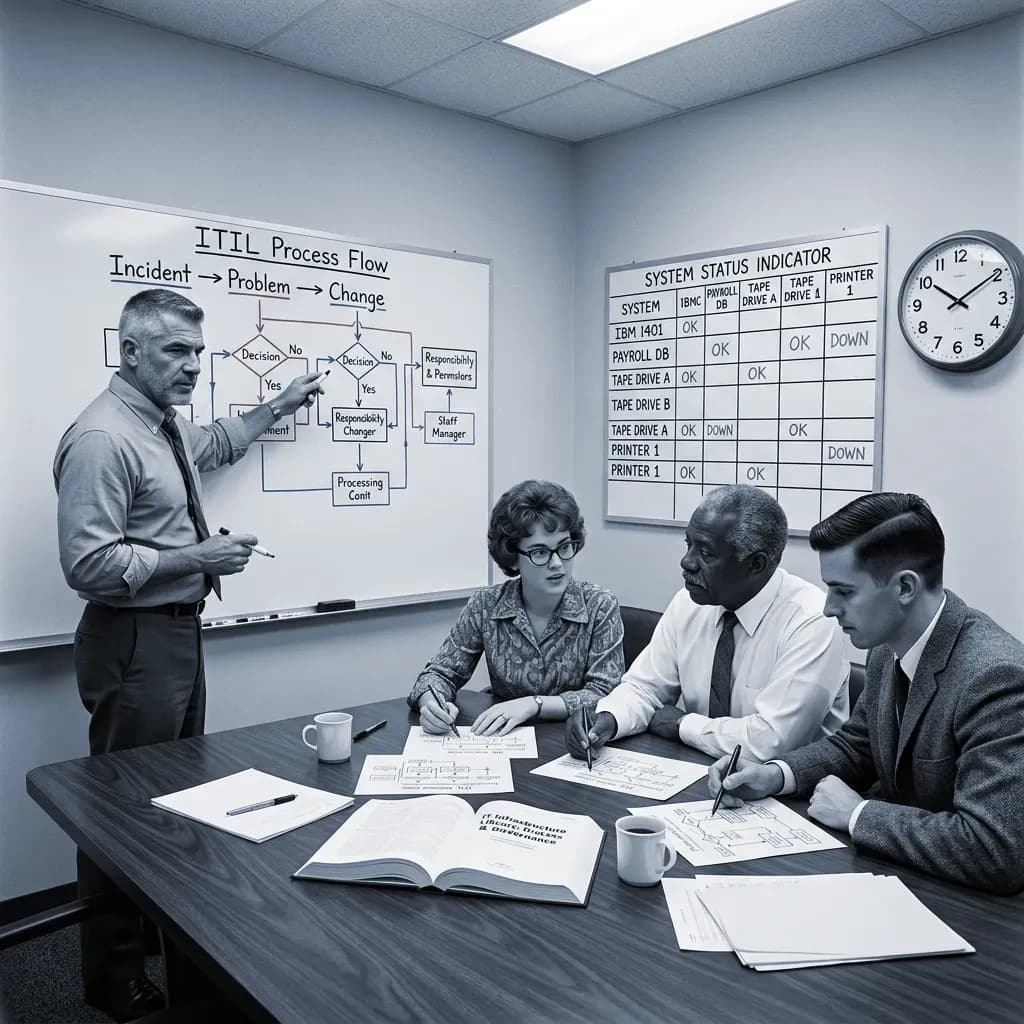
How do life sciences companies set up IT process management along ITIL and GxP so that incident, change and service delivery run efficiently and stand up to inspection?
We structure IT Process Management along ITIL and GAMP 5: incident, problem, change, release and service request with clear responsibilities and auditable documentation. An IT change process running separately from QMS change control creates exactly the documentation gaps that stand out first in an FDA or MHRA inspection.
Overview
Why are IT operations processes compliance-critical in regulated companies?
IT operations processes along ITIL, structured against GAMP 5 and 21 CFR Part 11 · QMS-integrated IT change management
Last updated: June 13, 2026
In life sciences, IT operations processes are not just an efficiency topic. As soon as a system generates, processes or stores GxP-relevant data, the process by which that system is operated and changed becomes a subject of inspection itself.
- Incident management without criticality logic: GxP-critical system failures run through the same queue as a forgotten password. Annex 11 requires documented procedures for handling incidents on computerised systems, including an assessment of data integrity after an event.
- Separate IT change management: changes to validated systems run in the IT tool, while QMS change control hears nothing about them. GAMP 5 and Annex 11 require that changes to validated systems be controlled, assessed and documented. The rift between the two worlds is the most common inspection finding.
- Service requests without an SLA structure: access provisioning and user provisioning follow no defined, traceable procedure. 21 CFR Part 11 and Annex 11 require controlled, documented system access.
- Missing process documentation: backup, recovery, monitoring and access provisioning are lived practice but are not captured in SOPs and RACI matrices. What is not documented counts as non-existent in an audit.
Services
How we support you
IT Process Analysis & Framework Design
Gap analysis of the existing operations processes (incident, problem, change, release, service request) against ITIL 4 and GAMP 5. The deliverable is an IT process framework tailored to company size and regulatory depth, with a documented process map.
Incident & Problem Management
Introduction of a GxP-compliant incident process with a prioritization matrix based on GMP criticality, escalation paths and root cause analysis for events with a data integrity bearing under Annex 11. Deliverable: incident SOP plus prioritization and escalation matrix.
Process Documentation & SOP Development
Documentation of all IT operations processes as SOPs, work instructions, RACI matrices and process flow diagrams. Deliverable: an auditable SOP set that makes backup, recovery, monitoring and access provisioning demonstrable for inspection.
Service Management & SLA Definition
Building a service request and service level model along ITIL 4 and ISO/IEC 20000: a catalog of IT services, defined handling and response times, and traceable user provisioning. Deliverable: service catalog with SLA definitions.
How we work together
What it comes down to
In regulated operations, IT has to be both efficient and inspection-ready, and both rest on the same piece of groundwork. It starts with the criticality assessment: only once it is clear which systems generate GxP-relevant data can incident management be prioritized meaningfully and change management be handed over to QMS change control at the right point.
Skip this assessment and you build either a framework that is too heavy for operations to live, or one too shallow that treats GxP-critical events like routine tickets. Both mistakes create the same gap between the documented and the lived process, and that gap is exactly what becomes the finding in an audit.
The real bottleneck sits, in nearly every case, at the interface between IT and quality. An IT change process that runs separately from QMS change control breaks a system's validation evidence the moment a configuration is changed without the change being assessed and documented.
That is why we first define the handover point between the two worlds, the GxP impact assessment under GAMP 5, before we shape the individual operations processes along ITIL 4.
This keeps operations fast where they are allowed to be fast, and controlled where Annex 11 and 21 CFR Part 11 require it.
Our approach
Our approach
Step
Result
Gap analysis
Prioritized list of findings: where the operations processes deviate from ITIL 4 and the GxP requirements from GAMP 5 and Annex 11, and what is inspection-critical.
Framework design
Tailored IT process map with defined processes for incident, problem, change, release and service request.
Define the change interface
Defined handover points between IT change and QMS change control, with a GxP impact assessment under GAMP 5.
Process documentation
SOPs, work instructions and RACI matrices that make every operations process auditable.
Rollout & training
Implemented processes, trained roles and an operational service management function with defined SLAs.
Common pitfalls
Where projects commonly fail
IT change and QMS change control run in two separate systems.
A configuration change to a validated system is logged in the IT tool but never assessed in change control. In the inspection the gap surfaces because the system's validation status is no longer traceable.
Incident prioritization has no notion of GMP criticality.
A failure of the system that generates batch records ends up in the same queue as a printer problem. Annex 11 requires documented handling of incidents for computerised systems, and a flat prioritization does not meet that.
Problem management is missing entirely.
Every incident is resolved individually, but no one looks for the root cause of recurring failures. The same GxP-critical fault occurs repeatedly without a documented root cause analysis, a pattern that an audit treats as uncontrolled operations.
Access provisioning is lived practice but not documented.
User provisioning and revocation of access rights happen by word of mouth instead of through a defined service request process. 21 CFR Part 11 and Annex 11 require controlled, demonstrable system access.
The framework is set up too large.
A complete ITIL process body is imposed on a small operation that does not live it. The SOPs exist on paper while real-world operations diverge from them. The discrepancy between the documented and the lived process is itself a finding.
Supply Chain & Technical Operations
Do any of these pitfalls apply to you?
In a first call we assess your situation and say what needs clarifying first in your case. Without obligation, reply usually within one working day.
FAQ
Frequently asked questions
Sources
- FDA 21 CFR Part 11, Electronic Records; Electronic Signatures (primary text)
- EudraLex Volume 4, EU GMP Guidelines Annex 11, Computerised Systems (primary text)
- ISPE GAMP 5, A Risk-Based Approach to Compliant GxP Computerised Systems
- ISO/IEC 20000, Information technology, Service management
Image notice: The images on this page were generated using artificial intelligence. They do not depict real people, places, or events.
Life Science Journal
Regulatory updates, straight to your inbox.
New requirements, authority decisions and practice notes. Once a month, unsubscribe any time.
Case Studies
What this looks like in practice

Latest insights
All insights →Regulations & standards considered
- FDA 21 CFR Part 11 (Electronic Records; Electronic Signatures)
- EU GMP Guidelines Annex 11 (Computerised Systems)
- ISPE GAMP 5 (Good Automated Manufacturing Practice)
- ITIL 4 (IT Service Management Framework)
- ISO/IEC 20000 (IT Service Management)
Related topics
Computer System Validation (CSV) →
CSV for GxP systems under GAMP 5 and Annex 11, the validated system that the operations processes rest on
Change Management →
The QMS change control that the IT change process is connected to
21 CFR Part 11 & Data Integrity →
Requirements for electronic records and access control that IT processes must meet
Digitalization in Life Sciences →
The transformation side: IT Process Management optimizes ongoing operations, not the rebuild
Have a concrete project?
Briefly outline your situation. We'll respond with an initial assessment, usually within one business day.
Prefer direct? +39 02 8904 1000
info@theentourage.it
- Reply usually within one working day
- 4 locations: DE · CH · IT · US
- 100% life sciences