
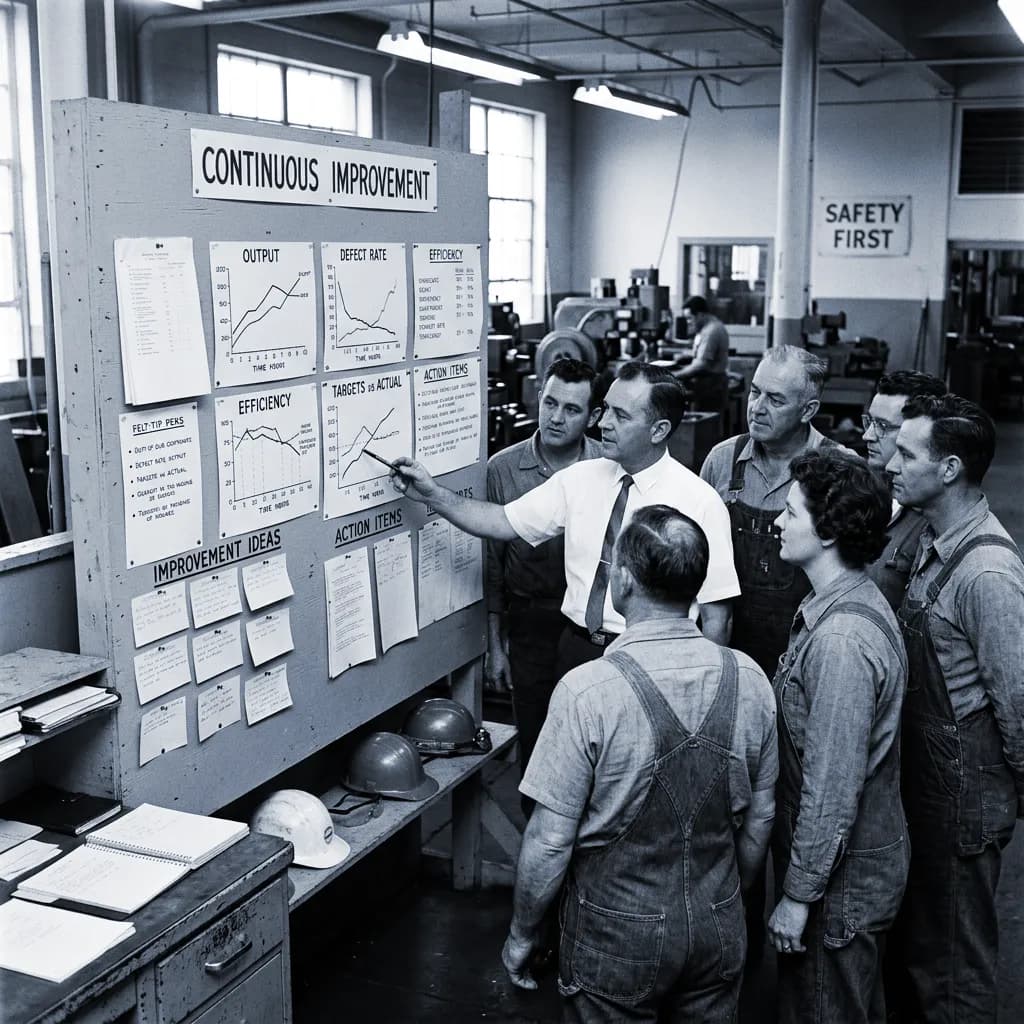
How do life sciences companies embed a lasting culture of continuous improvement instead of one-off flash-in-the-pan projects?
We help pharma, biotech, MedTech and IVD companies build structured continuous improvement programs: idea management, prioritization, KPI-based measurement and internally trained multipliers. Improvements that bypass approval in a GMP environment turn into an audit finding instead of progress.
Overview
Why do improvement initiatives in life sciences lose their momentum?
Internally trained multipliers instead of permanent external dependence · Integration into change control and ISO 13485:2016 management review
Last updated: October 4, 2026
Many improvement initiatives start strong and fall back into old patterns after just a few months. In the regulated environment, an additional hurdle comes into play: every process change affects validated states and must pass through the change control system.
- Improvement projects are launched without a clear methodology and without designated ownership; once the project ends, the structure that would carry it forward is missing.
- Employees are not involved, improvement remains a management matter; without broad participation no culture emerges, only an isolated initiative.
- Measures are not measured against KPIs; successes remain invisible and lose the management commitment that ISO 13485:2016 already demands through the management review.
- The CIP process is not linked to change control under the EU GMP Guide; improvements in the GMP environment require impact assessment, QA approval and, where applicable, revalidation, otherwise they become a compliance risk.
Services
How we support you
CIP System Design & Rollout
Building a complete continuous improvement system with idea management, a prioritization process, project governance and performance measurement. Deliverable: a documented CIP process aligned with GMP requirements and with the existing change control system.
Kaizen Events & Rapid Improvement Workshops
Structured 3- to 5-day Kaizen workshops on a defined process topic with the operational team. Deliverable: a prioritized list of measures with owners, whose results are fed directly into quality change control.
Internal Multipliers & CIP Coaches
Training and mentoring of internal Lean and CIP coaches as well as improvement champions. Deliverable: enabled internal champions who carry the program forward after the project ends without permanent external dependence.
OpEx Boards & Management Reporting
Introduction of operational excellence boards as visual management for improvement status, KPIs and open measures. Deliverable: a board structure and reporting metrics integrated into the management review under ISO 13485:2016.
How we work together
What it comes down to
What decides a continuous improvement program is rarely the method it picks, but what is in place before the first workshop. First it needs a baseline: without a measured starting point, no success can later be demonstrated, and without demonstrated success the program loses the management commitment that ISO 13485:2016 already requires through the management review.
Only then comes the system design with idea management, prioritization and performance measurement, and only last the individual Kaizen events. Start with workshops before methodology, ownership and KPIs are in place, and the program produces a run of short-lived pushes rather than a structure that holds.
The real hurdle in the regulated environment is the link to the change control system under the EU GMP Guide. Every process improvement affects validated states and requires impact assessment, QA approval and, where applicable, revalidation.
When the CIP process is linked to change control from the outset, improvement runs in step with compliance; when it is routed around it, the fastest measure becomes the most expensive finding in the surveillance audit.
This is precisely why we train internal multipliers instead of permanent dependence: an improvement culture is only sustainable if the organization carries it forward itself.
Our approach
Our approach
Step
Result
Current-State Assessment & Baseline
Evaluation of the current improvement practice and the KPI starting point; gaps in methodology, ownership and change control linkage made visible.
CIP System Design
A documented continuous improvement process with idea management, prioritization and performance measurement, linked to the change control system.
Pilot & First Kaizen Events
First implemented measures with owners, whose results are approved through quality change control.
Enabling Internal Champions
Trained CIP coaches and improvement champions who carry the program forward internally.
OpEx Board & Management Review
An established management board with KPIs, integrated into the management review under ISO 13485:2016.
Common pitfalls
Where projects commonly fail
The CIP process bypasses change control.
A process improvement in the GMP environment without impact assessment and QA approval under the EU GMP Guide affects validated states and turns into an audit finding instead of progress.
The program depends on external consulting.
If no internal champions are trained, the improvement momentum ends with the consulting engagement; sustainability arises only through internal enablement and leadership commitment.
Improvements are not measured against KPIs.
Without a baseline and visible metrics, successes remain invisible, management loses interest and the initiative peters out between day-to-day operations.
Kaizen is misunderstood as a method.
If short Kaizen workshops are applied to complex, data-intensive problems, the analytical depth is missing; such topics belong in a more structured DMAIC cycle rather than in a 3- to 5-day event.
Improvement remains a management matter.
If ideas do not come from the operational team and no structured channels for submission exist, no culture emerges, only a top-down initiative without broad impact.
Quality Management & Compliance
Do any of these pitfalls apply to you?
In a first call we assess your situation and say what needs clarifying first in your case. Without obligation, reply usually within one working day.
FAQ
Frequently asked questions
Sources
- ISO 13485:2016, Quality management systems for medical devices (management review)
- ISO 9001:2015, Quality management systems, continual improvement
- EU GMP Guide, change control / quality change management
Image notice: The images on this page were generated using artificial intelligence. They do not depict real people, places, or events.
Life Science Journal
Regulatory updates, straight to your inbox.
New requirements, authority decisions and practice notes. Once a month, unsubscribe any time.
Case Studies
What this looks like in practice

More projects on this topic
- Lean Six Sigma in Sterile Filling and Packaging→
- OEE and Output Improvement for a Pharma and Medtech Manufacturer→
- OEE Optimization in the Production of Biochemical Active Ingredients→
- Operational Excellence in Pharma Engineering→
- Optimizing Cleaning Validation for Complex Product Lines→
- Optimizing the Entire QC Laboratory Environment→
- Product Portfolio Restructuring and Go-to-Market Strategy for a Medtech Manufacturer→
- Project Cost Control Through Real-Time Dashboards→
- QC Lab Optimization Through Clear Roles and Kanban Control→
- Quality Control Transformation for Higher Productivity→
- Transparency and Control in the R&D Project Portfolio→
- Turnaround Management for Production Stability and Quality Optimization in Regulated Manufacturing Processes→
Related insights
All insights →Regulations & standards considered
- ISO 13485:2016 (QM system for medical devices, management review)
- ISO 9001 (QM system, continual improvement)
- EU GMP Guide (change control / quality change management)
- EU 2017/745 (MDR)
- EU 2017/746 (IVDR)
Related topics
Change Management →
GMP-compliant change control as a prerequisite for CIP measures
CAPA Management →
Corrective and preventive actions as a systematic improvement lever
Deviation Management →
Deviations as a recurring source of improvement needs
State-of-the-Art Assessments →
Benchmarking as a starting point for an improvement program
Have a concrete project?
Briefly outline your situation. We'll respond with an initial assessment, usually within one business day.
Prefer direct? +39 02 8904 1000
info@theentourage.it
- Reply usually within one working day
- 4 locations: DE · CH · IT · US
- 100% life sciences